
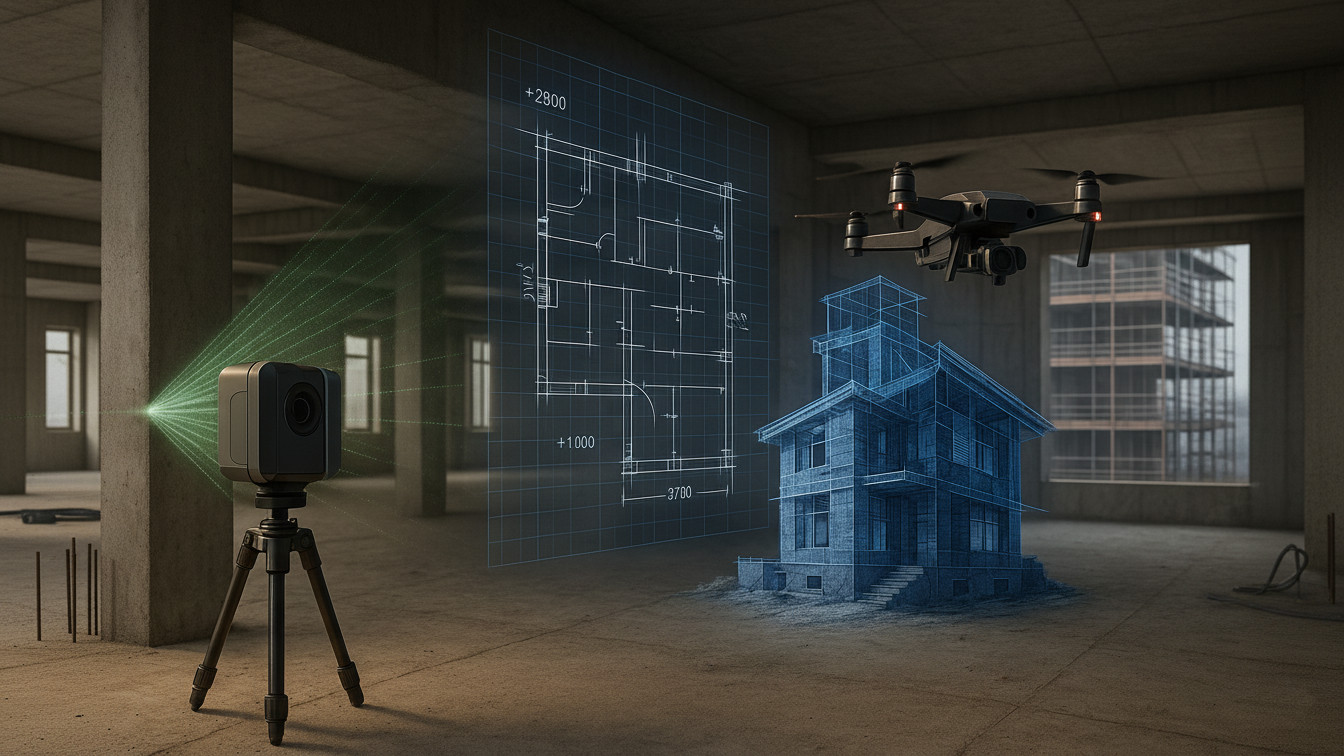
The most defensible way to choose a capture method for BIM is to begin with requirements, not tools. Two anchors help: the USIBD Level of Accuracy (LOA) specification — v3.1 released in 2025 — and the ISO 19650 suite for information management. LOA v3.1 clarifies how to express tolerances using standard deviation (SD) language, making it easier to write acceptance criteria that vendors can test and verify. Coupled with ISO 19650 information-delivery processes, this lets teams specify exactly how accurate “as-built” models must be and how that accuracy will be demonstrated.
Meanwhile, acceptance testing shouldn’t be a guessing game. ASTM E3125-17 defines point-to-point distance tests for medium-range 3D imaging systems (e.g., terrestrial laser scanners and many SLAM devices). Owners can require that suppliers run an E3125-style test and report the results alongside LOA claims; the method is designed to produce comparable, repeatable error numbers. NIST’s documentation explains the test artifacts (including relative-range checks) and their purpose.
In practice, reported accuracy is often summarized as an RMSE across checkpoints:
RMSExyz = √ ((1/ n) · Σ (dx2 + dy2 + dz2))
LOA v3.1’s SD-based phrasing helps connect those checkpoint statistics to model tolerances in clear, contractual language. Requesting E3125 reports (or equivalent) with the how and the numbers keeps promises like “±10 mm” honest.
Tripod TLS (static LiDAR). The workhorse for tight tolerances. At short to medium range, modern scanners routinely deliver repeatable millimeter-class results, and they are robust in low-light, low-texture interiors where image matching struggles. TLS also aligns neatly with E3125 acceptance testing, because the test was written around spherical-coordinate systems typical of TLS. The trade-off is slower setup and more stations to plan.
Mobile/SLAM LiDAR. The speed champion indoors. SLAM scanners cover large floorplates quickly; with well-designed loop closures and QA checkpoints, published indoor evaluations report errors on the order of a few millimeters to ~1–1.5 cm, while reputable vendor claims cluster around ±10–15 mm for indoor absolute accuracy. Treat those figures as achievable with good practice, not automatic. Structured spaces help; long, feature-poor corridors increase drift risk unless loops and anchors are planned.
Photogrammetry (UAV/terrestrial). Superb for exteriors and texture-rich scenes, and often the most cost-efficient on a per-area basis. However, photogrammetric metric quality depends strongly on control design and imaging discipline. RTK or PPK image centers reduce fieldwork, but studies keep showing that GCP distribution — especially vertical distribution on roofs or facade features — materially improves height/facade accuracy when tolerances are tight. Classic CIPA 3×3 guidance (coverage, overlap, fixed optics, orthogonal views) remains a practical checklist.
In narrow, high-throughput scenarios, bespoke SLAM loop-closure or anchor-injection routines can reduce drift versus default pipelines; for most building scopes, off-the-shelf workflows are sufficient.
For photography, stick to the simple things that work: constant focal settings, adequate overlap, orthogonal passes for rectification, and a thoughtful GCP layout that isn’t confined to a single plane. Where facades and vertical datums matter, add measured points at different heights (e.g., rooflines, parapets); recent work quantifies the improvement when rooftop control is included.
For SLAM, close loops (return to start), place surveyed checkpoints you can re-observe independently, and — where supported — ingest control targets to cap drift and ease geo-registration. Keep a short, repeatable validation route you can rescan if anomalies appear. Published evaluations emphasize that these basics often make the difference between centimeter-class and disappointing results.
| Method | Typical indoor accuracy | Capture speed | Control needs |
|---|---|---|---|
| Tripod TLS | ~2–5 mm (short range) | Slow–med | Targets/registration; E3125 checks |
| Mobile/SLAM LiDAR | ~10–15 mm absolute | Fast | Closed loops + QA checkpoints |
| Photogrammetry (UAV/terrestrial) | ~5–20 mm with RTK + GCPs | Med | Strong GCP layout + calibration |
Figures reflect standards-based evaluation framing (ASTM E3125), published SLAM accuracy comparisons, and recent RTK/GCP distribution studies — treat them as planning ranges, not guarantees.
| Condition | TLS | SLAM LiDAR | Photogrammetry |
|---|---|---|---|
| Low light | Unaffected | Unaffected | Degrades (blur/noise) |
| Low texture/monochrome | Strong | Strong | Degrades (fewer tie points) |
| Vegetation | Penetrates gaps | Similar to LiDAR limits | Captures canopy “skin” |
These patterns align with the fundamental sensing modalities: active range measurement (LiDAR) versus passive image matching (photogrammetry). They explain why, for example, a dark plant room leans TLS, while a textured exterior favors UAV imaging.
Small specification changes eliminate big headaches: